

The Royal Australian and New Zealand College of Obstetricians and Gynaecologists (RANZCOG) has called for the Federal Parliament to reject the Human Rights (Children Born Alive Protection) Bill 2026, introduced by Nationals MP Llew O’Brien on 17 August.[i]
RANZCOG claims the Bill is unnecessary, will create confusion for medical practitioners and could reduce access to abortion.[ii] But these arguments miss the fundamental issue the Bill seeks to address.
The Bill is not about determining which unborn children are worthy of protection. Every child, before and after birth, possesses inherent human dignity and value. Rather, it addresses the specific circumstances that arise when an abortion attempt results in a child being born alive. Their circumstances have changed, but their worth has not. The fact that an abortion was attempted should never diminish the protection or care owed to a child who survives and is born alive.
Importantly, Queensland Health’s own clinical guideline recognises this principle. It states that once a baby is born alive, they become a person with legal status and rights independent of the parent, and that care should be provided in the baby’s best interests and according to the individual clinical circumstances.[iii]
RANZCOG argues that babies born before 22 weeks are considered pre-viable and that active treatment may be medically futile. But the Bill does not require doctors to provide futile treatment. Rather, it provides for care appropriate to the circumstances, including life-sustaining treatment where appropriate and palliative care where treatment would not be in the child’s best interests.
This is not merely a theoretical issue. In November 2023, LNP MP for Oodgeroo, Dr Mark Robinson, asked the Minister for Health, Labor MP Shannon Fentiman, a question on notice regarding the number of babies born alive following an abortion in Queensland between 2018 and 2022. The response provided the following statistics:
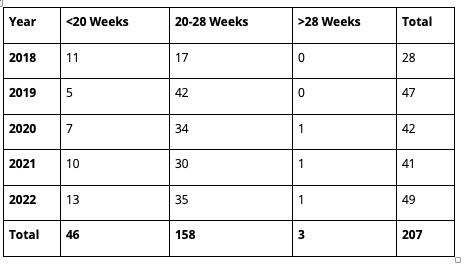
In total, 207 babies were born alive following an attempted abortion in Queensland between 2018 and 2022. The figures show that this is not simply a theoretical or hypothetical scenario.
Queensland Health does not require the reasons for late-term terminations to be disclosed for statistical purposes. Consequently, the available data cannot tell us the circumstances surrounding each of these cases. What it does establish is that live births following attempted abortions are occurring in Queensland, and in significant enough numbers to warrant proper consideration and transparent reporting.
To suggest that babies being born alive following an abortion “doesn't happen” or is too rare to warrant legislative consideration is therefore inconsistent with Queensland's own reported data.
The crucial question is not whether every baby born alive can be saved. It is whether a baby's care should be determined by the fact that their birth followed an attempted abortion. It should not.
RANZCOG says existing professional standards already impose a duty of care. If that is the case, there should be no reason to oppose legislation that reinforces the basic principle that a child born alive is entitled to appropriate care. It simply does not make sense.
The Bill also seeks to improve transparency by requiring information about live births following attempted abortions to be reported nationally. Queensland already recognises these events within its health system and has specific clinical guidance for their management.[3] Yet Australia does not currently have comprehensive national reporting of these events.
The principle at stake is simple. We do not determine whether a newborn deserves care based on whether their birth was intended. A premature baby born spontaneously is assessed according to their medical condition and cared for accordingly. A baby born alive following an attempted abortion should receive no lesser consideration simply because their existence was unintended.
Birth should bring equality, not a lesser standard of protection.
Cherish Life welcomes Mr O’Brien’s Bill and urges MPs from every political party to support this basic safeguard for Australia’s most vulnerable children.
[i] Parliament of Australia. (2026). Human Rights (Children Born Alive Protection) Bill 2026. Introduced in the House of Representatives on 17 August 2026.
[ii] Royal Australian and New Zealand College of Obstetricians and Gynaecologists. (2026, August 26). Human Rights (Children Born Alive Protection) Bill 2026 will reduce access to essential abortion care. https://ranzcog.edu.au/news/human-rights-children-born-alive-protection-bill/
[iii] Queensland Health. (n.d.). Queensland Clinical Guideline: Termination of pregnancy, section 7.3, “Born with signs of life”. The guideline states that once born alive, a fetus becomes a person with legal status and rights independent of the parent and should receive care appropriate to the individual clinical circumstances.